Jan 26, 2026
AI Visibility Study: Design & Prototyping Tools
A GEO Advisor study on how UI and UX design tools appear in AI search. Based on 300 prompts, we analyze which platforms get recommended, how they are framed, and which buying signals drive AI visibility.
Content
Why we ran this study
At GEO Advisor, we run cross-category benchmarks to understand how software products appear in AI generated answers. As designers, founders, and product teams increasingly ask AI which tools to use, visibility inside models is becoming a meaningful distribution channel.
This study focuses on UI and UX design and prototyping tools. We wanted to understand which products AI recommends, how they are positioned, and what tradeoffs consistently shape sentiment.
Methodology
We tested 300 design-related prompts covering:
Tool recommendations by team type
Prototyping and collaboration workflows
Comparisons between leading platforms
For each brand, we measured:
Mention rate
Sentiment
Share of voice
We combined these signals into a single AI Visibility Score and analyzed how models describe strengths and limitations.
Top results
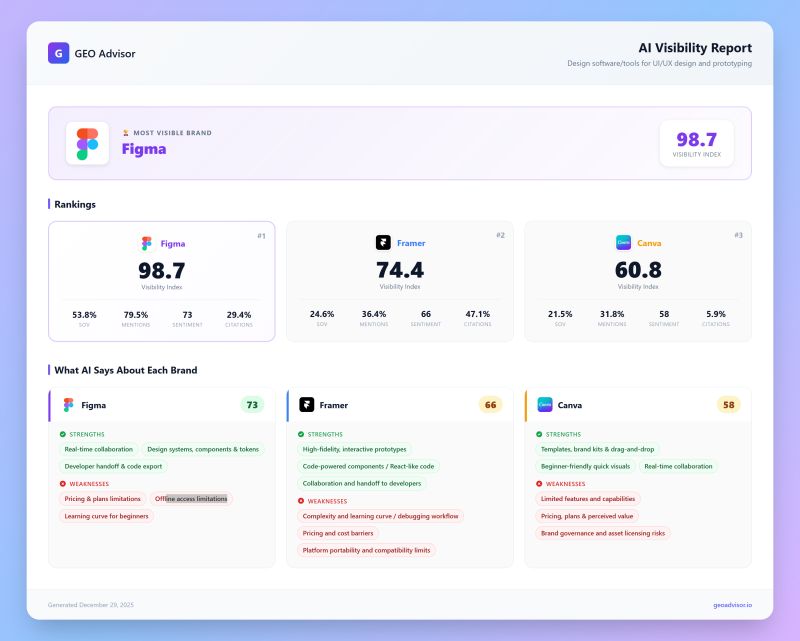
Figma — 98.7
Mentioned in 79.5 percent of queries
Share of voice: 53.8 percent
Figma overwhelmingly dominates AI visibility in design tooling. Models consistently treat it as the default collaborative design platform for modern teams.
Strengths surfaced by AI:
Real time collaboration across teams
Mature design systems with components and tokens
Strong alignment with how product teams scale design
Tradeoffs surfaced by AI:
Pricing and plan limitations as teams grow
Lack of offline access becoming a constraint in some environments
Figma wins because AI sees it as infrastructure, not just a tool.
Framer — 74.4
Mentioned in 36.4 percent of queries
Share of voice: 24.6 percent
Framer appears when the context shifts toward interactive, high fidelity prototypes and production-ready design. AI often frames it as powerful, but specialized.
Strengths surfaced by AI:
Code powered, React-like components
High fidelity interactions and animations
Strong bridge between design and implementation
Tradeoffs surfaced by AI:
Steeper learning curve compared with visual-first tools
Debugging complexity and pricing friction for non-technical teams
Framer is recommended when teams value realism and execution over accessibility.
Canva — 60.8
Mentioned in 31.8 percent of queries
Share of voice: 21.5 percent
Canva shows up as the fast, beginner-friendly option. AI recommends it for lightweight design needs and non-designer workflows.
Strengths surfaced by AI:
Template driven design and drag and drop workflows
Brand kits that simplify consistency
Very fast time to value
Tradeoffs surfaced by AI:
Limited depth for advanced design systems
Pricing and perceived value cap its role beyond lightweight use cases
Canva wins on speed and accessibility, but AI rarely frames it as a scalable design platform.
Big takeaway
In design tooling, AI strongly favors collaboration, shared systems, and scalability. Platforms win visibility when they align with how teams actually work together across design, product, and engineering.
At the same time, pricing friction, learning curves, and offline constraints meaningfully shape where AI draws the line between default recommendation and niche use case.
For design tool vendors, AI visibility is not just about features. It is about whether the product maps cleanly to real team workflows and scales with them.