Jan 15, 2026
Part 2: Why personas come before queries in GEO
In the last post, I explained why real GEO measurement requires hundreds of queries. Not screenshots. Not a handful of prompts. Actual volume.
The next question is obvious. Where do those queries come from?
They come from personas.
The same question does not get the same answer
I asked ChatGPT the same question twice.
What is the best CRM?
The answers were completely different.
For an enterprise buyer, the model recommended Salesforce and HubSpot. For a solopreneur, it surfaced Notion and Airtable.
Same query. Different context. Different recommendation set.
This is the part most GEO approaches miss entirely. They test queries in a vacuum, assuming the same question always produces the same answer. It does not.
AI recommendations are context driven
AI personalizes recommendations based on inferred intent.
Ask best running shoes and the answer changes depending on who you are. A marathon runner training for their first race gets a different response than a casual jogger. The model picks up on those signals and adjusts.
That is why the first question in GEO is not what queries should we track.
It is who are we tracking them for?
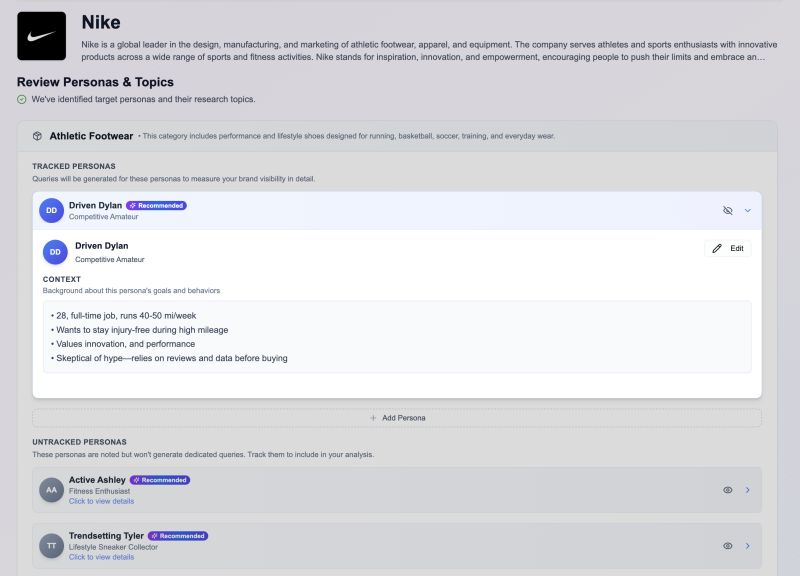
Personas come first. Everything else follows.
Personas define competitors, topics, and queries
Once you define your personas, the rest becomes much clearer.
For each persona, you can answer:
Which competitors show up in their context
Which topics actually matter to them
Which queries reflect real buying intent
Without personas, you end up tracking generic queries that do not map to real decision making.
Volume still matters
Even with strong personas, you still need scale.
AI responses are non deterministic. Run the same query tomorrow and you may get a different answer. Patterns only appear when you run hundreds of queries per persona and category.
This is why most GEO audits fail. They give you a blank spreadsheet, ask you to come up with 15 to 20 queries, add no persona context, and call it analysis.
That is not measurement. That is noise.
What good GEO setup looks like
Start simple.
One to two personas per product category
Be specific. Marathon runners training for their first race, not athletes
Map competitors, topics, and queries for each persona
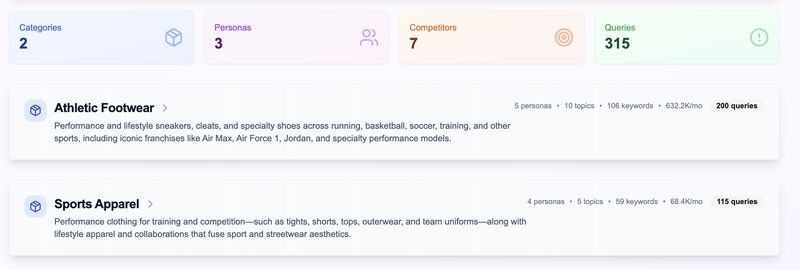
When set up correctly, you should be able to see at a glance:
How many personas you are tracking
How many competitors per category
How many queries are running per persona
This structure is what turns GEO from an abstract idea into something you can actually measure and improve.
What’s next
In the next post, I will break down how personas shape the specific topics and queries you should be measuring, and how to avoid over indexing on generic keywords that do not move AI recommendations.
If you are serious about GEO, this is where it starts.