Jan 31, 2026
Part 4: How to generate queries for GEO
You have your personas.
You have your topics.
Now you need queries. Hundreds of them.
In the last post, I explained how topics bridge personas to measurement. But a topic like running shoes for marathons is not something an AI model responds to directly. You need to expand each topic into the actual questions people ask.
That is where query generation comes in.
Topics are not queries
A topic defines an area of interest. Queries are how that interest shows up in real language.
People do not ask AI about topics. They ask questions. And the way those questions are framed changes both which brands appear and how they are positioned.
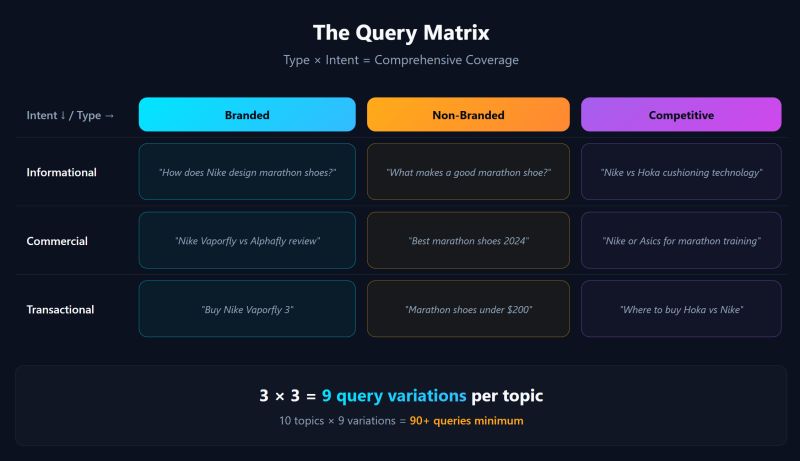
To generate queries systematically, you need two dimensions: query type and intent.
Dimension 1: Query type
Query type answers a simple question. Who is referenced in the question?
There are three types that matter for GEO.
Branded queries
Questions that reference your brand directly.
Examples:
Is Nike good for marathons
Nike marathon shoe reviews
These measure recall. Does the model surface your brand when it is explicitly asked about?
Non branded queries
Category level questions with no brand mentioned.
Examples:
Best marathon running shoes
Top shoes for long distance
These measure discovery. Do you appear when the user has not chosen a brand yet?
Competitive queries
Head to head comparisons.
Examples:
Nike vs Hoka for long distance
Asics or Brooks for marathons
These measure preference. When AI compares options, which way does it lean?
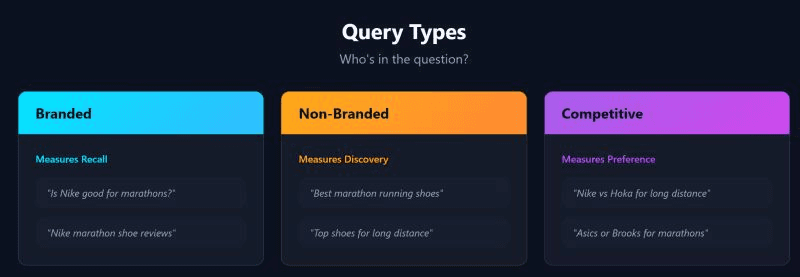
Each type tells you something different. You need all three.
Dimension 2: Search intent
The second dimension is intent. Where is the user in their journey?
Informational
Learning mode.
Example: What makes a good marathon shoe?
Commercial
Comparing options.
Example: Best marathon shoes 2024.
Transactional
Ready to buy.
Example: Nike Vaporfly price.
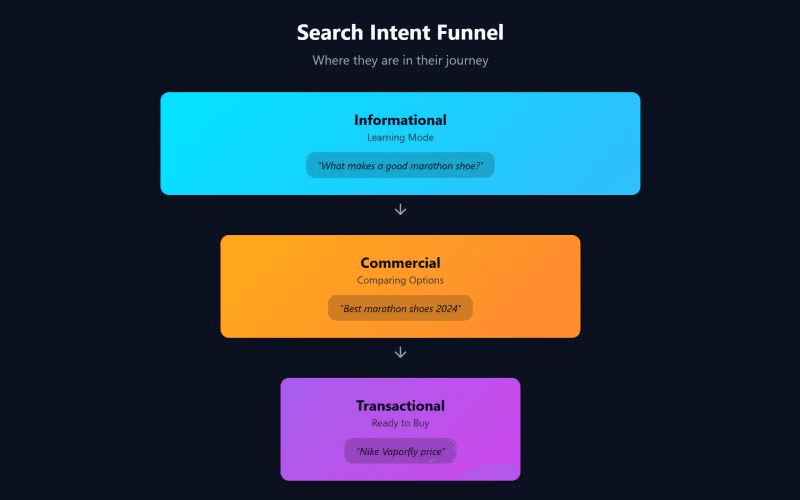
Intent matters because AI responses change as users move closer to a decision. Brands that show up early are not always the ones that close.
The query matrix
Now you multiply.
Every topic needs coverage across:
3 query types
3 intent levels
That gives you 9 query variations per topic.
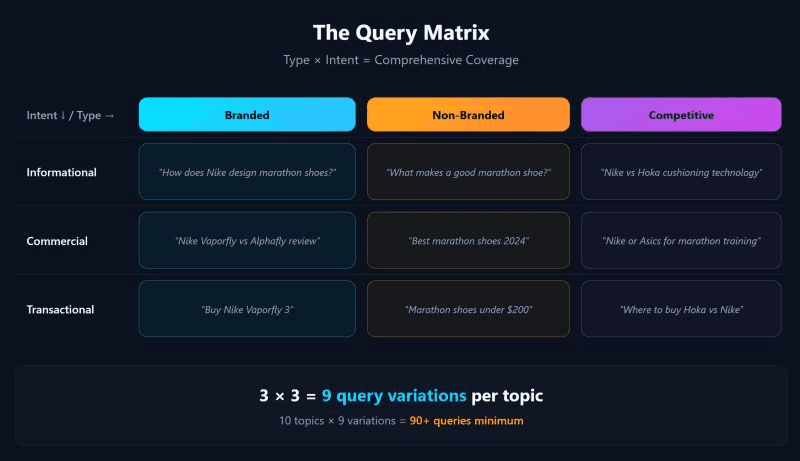
If you track 10 topics, that is already 90 queries. Add multiple personas and categories, and you quickly get to 300 plus.
This is not overkill. This is what it takes to see real patterns in non deterministic systems.
Why manual query lists fail
I have seen teams spend days building query lists by hand. By the time they finish, AI responses have already shifted. Models update. Training data changes. Context windows evolve.
The landscape moves faster than manual processes allow.
If your GEO strategy relies on static query lists and one off audits, you are always looking at a snapshot that is already outdated.
What’s next
In the next post, I will cover how to actually run these queries at scale and, more importantly, what to track once you do. Visibility alone is not enough. The value comes from understanding patterns, drivers, and movement over time.
This is where GEO stops being theory and starts becoming a system.